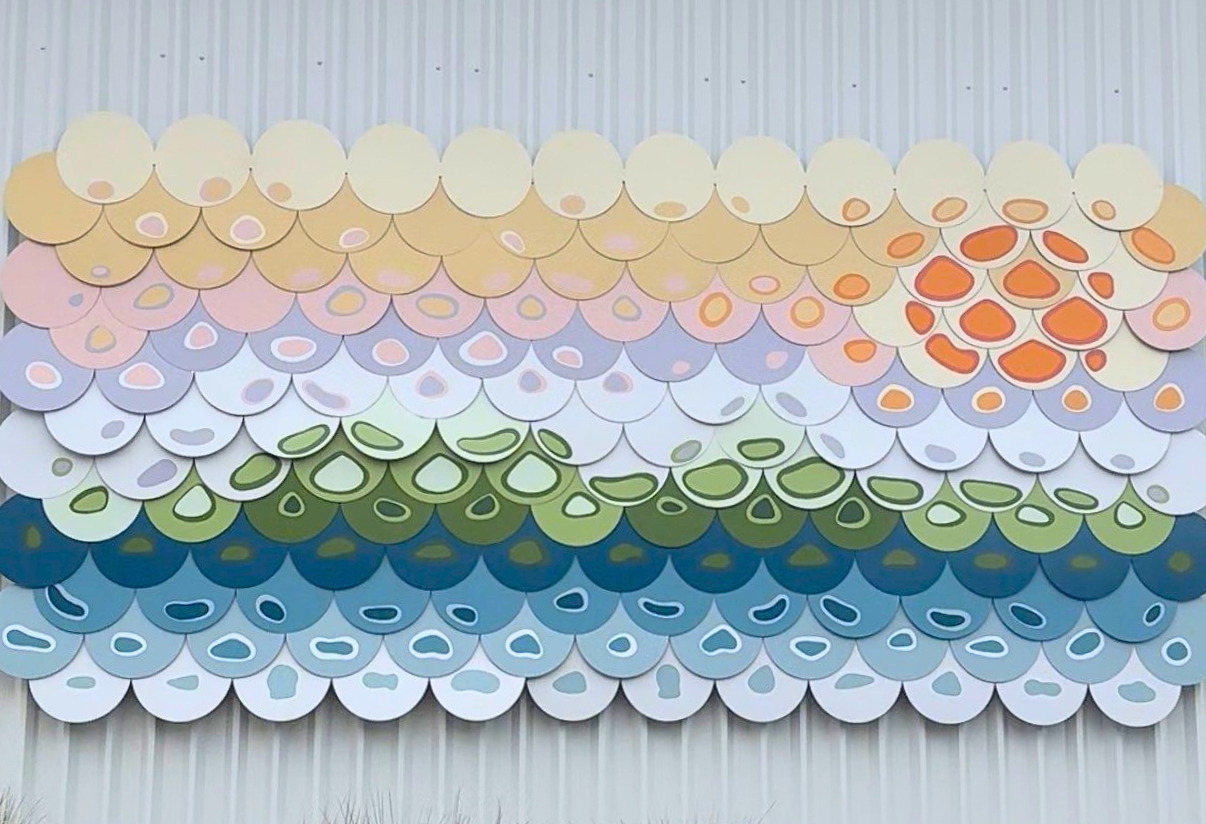
We recently visited Waihī Te Ara Mātauranga – Waihī Beach Library and Community Hub to meet artist Jess Ellis, who has just completed a striking new mural on the side of the building.
At the heart of Jess’s work is the ocean, a constant presence at Waihī Beach that connects people, place, and environment. Her piece brings together a wide range of elements, weaving them into a layered reflection of the surrounding landscape and the rhythms of coastal life.
The artwork itself is constructed from aluminium forms, each cut into scale-like shapes and layered to create texture and movement. Up close, these forms feel abstract -ripples, fragments, shifting shapes. But from a distance, they come together to suggest something more familiar: the view of Tuhua from Waihī Beach, rippled as though you are looking at a reflection on the water.
There’s a strong sense of place embedded throughout. References to the ocean, the sky, and the sun are all subtly integrated, grounding the work firmly in the Western Bay landscape. Hidden meanings sit within the shapes, colours, and techniques Jess has used inviting viewers to spend time with the piece and uncover new interpretations.
Light and movement play a key role. Distortions of colour and reflection mimic the way water shifts and changes, creating a sense of constant motion and connection between elements. The glossy finish of the paint enhances this effect – catching the sun, sometimes bright and almost harsh to look at, intentionally challenging how the work is experienced in different conditions and times of day.
Despite the complexity, the palette remains soft and flowing, carefully balanced to feel cohesive. Every detail works to reinforce a central idea: a deep connection between people and their environment.
Inside the library, this whakaaro continues through Ngā Tikanga o te Taiao, a large woven harakeke panel by local kairāranga Marino Magee. The work centres on three key tikanga; kōrero, karakia, and koha, guiding how we interact with the natural world and with each other.
Framed between Ranginui (the sky father) above and Papatūānuku (the earth mother) below, the weaving speaks to whakapapa and connection, reminding us that we exist within, not separate from, the environment.
Together, these two works create a powerful dialogue across the building. Jess’s mural reflects the movement, light, and physicality of the coastal environment, while Ngā Tikanga o te Taiao grounds that experience in values, how we move through that environment with care, intention, and respect.
It’s a conversation between inside and out, between abstraction and guidance, between seeing and understanding. And like the ocean at the centre of it all, both works invite you to pause, look closer, and consider your place within the wider landscape.