Creative Patapatai
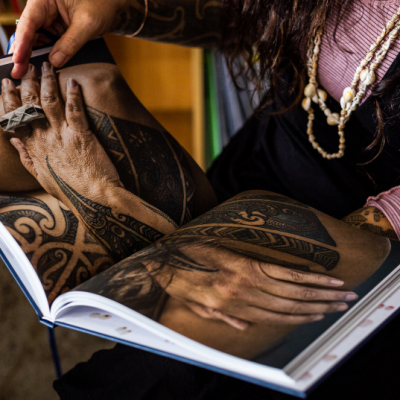
Todd Couper is a Bay of Plenty based contemporary Māori carver whose work is grounded in the rich traditions of whakairo while exploring its place in the present day. With roots in Wairoa and a practice shaped by decades of dedication to the craft, his carvings reflect both heritage and personal storytelling.
Read on to learn more about Todd’s creative journey, the artists who have influenced him, and the places that continue to inspire his work.
Your occupation, job title, artistic discipline (or very brief description of what you do):
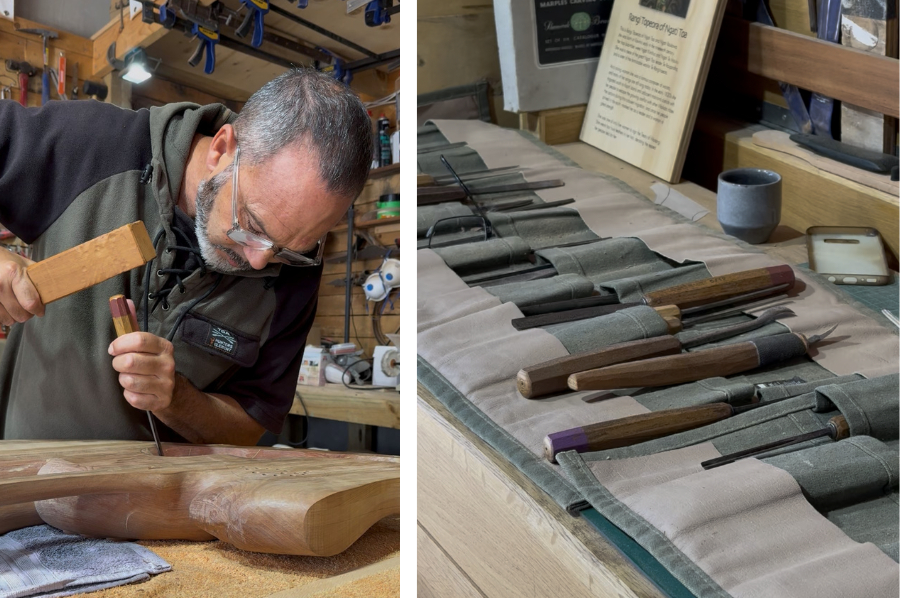
I am a full time artist, with my chosen medium being whakairo/contemporary Māori wood carving.
What cities/towns have you lived in (or spent more than a few months in), beginning with the place of your birth?
I was born in Wairoa. I went to Te Aute College in Pukehou, Hawke’s Bay, where I spent five years. After high school, I moved to Rotorua to study art at Waiariki Polytechnic for four years, graduating with a Diploma of Art, Craft and Design (Māori) in 1995. Following that, I worked alongside Roi Toia, forging a career as a full-time artist/carver. In 2012, my family and I moved to Brisbane, Australia, where I had a 12-month contract as Artist in Residence at Southbank Institute of Technology. In 2013, we returned to Aotearoa, settling in Pāpāmoa.
What are the earliest stories you remember hearing? The ones that told you about the world?
Probably listening to my Nan talk about her travels to America, Hawaii and Singapore, and looking through her photo albums when I was a kid.
What’s your favourite Bay of Plenty landscape, park, building, location, suburb, or side street? Why?
It would have to be Pāpāmoa Beach. I come from Wairoa on the East Coast, and the sea is one thing that has always been inviting. I like fishing, gathering kaimoana, and just enjoying the sand, sea and salty air. It’s a very calming space for me.
What’s an average day in your life at present?
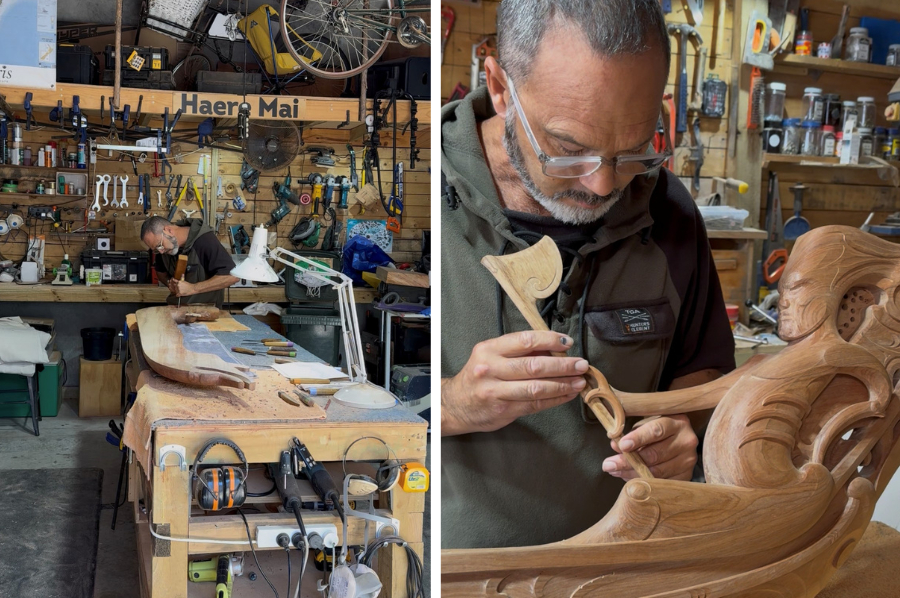
An average day for me is spent in the workshop carving, tending to my commissioned work, and fitting in some whānau time wherever I can.
What’s the one object from your home you would save from a fire?
My hard drive that has thousands of photos of family, good memories, and almost all of my work. These are precious things that can’t be replaced.
What music was present and still memorable from your youth/adolescence?
80s music for me. Every time I hear a good tune from the eighties it always reminds me of the cool, fun times growing up in Wairoa.
For you as a creative person, who are three influential artists or thinkers?
I have so many artists here and abroad, past and present, that have had an impact on me and my work. When it comes down to it, the three that have been the most influential, or who I have learnt the most from, are my three bros: Roi Toia, Fayne Robinson and Ian-Wayne Grant.
If you went away from the Bay of Plenty for a long time and then came back, what are the first three things you would do or visit?
I would catch up with old friends, go for a cruise down the Mount, and have a feed of fish & chips.
Looking back at your teenage self: what one sentence describes that person?
A quiet, humble kid with dreams and heaps of potential.
What are you planning for 2026 that nobody knows about yet?
Carving a piece for myself – one that I designed a few years ago that will be quite a personal piece. Then I’d like to cast it in bronze.
In one sentence, can you define creativity?
I think it’s the passion or desire to transform your ideas or ideals, your imagination and curiosities, into a physical representation.
Where would you like to live, but have yet to?
Maybe Māhia. It’s where I whakapapa to, where my whenua and my marae are, and it’s close to Wairoa, whānau and friends. However, even though my wife Ange is from Wairoa too, I might have to see what she thinks first…
What word of advice would you offer an aspiring creative person?
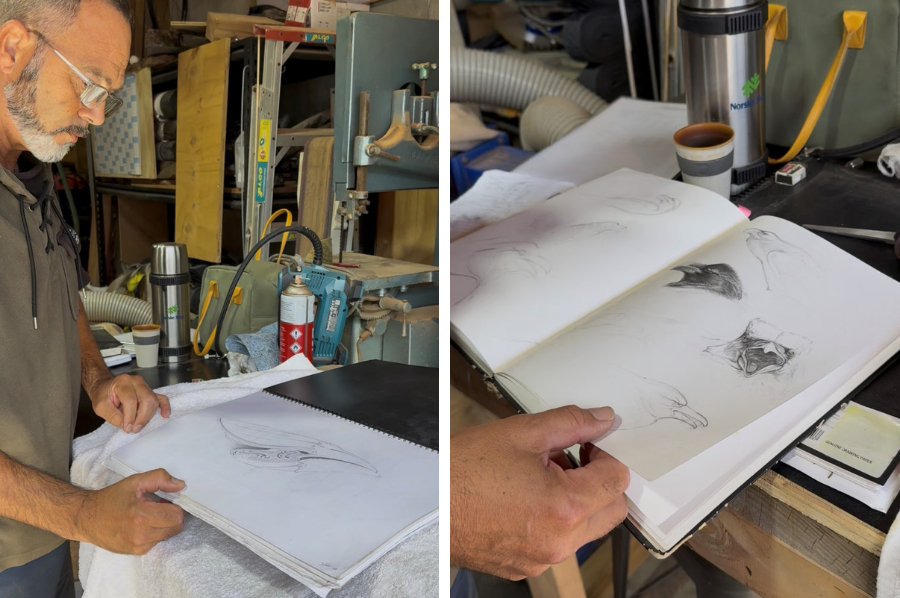
If I had any words of advice for our artistic rangatahi (younger generation), it would be to draw and sketch more. Drawing is often the first important step in translating a concept or idea by bringing it into a physical dimension. It’s like the basic underlying language of art that transcends all nationalities and cultures. Therefore, the more you practise and the better you become, the more your art will visually speak.
What is your dream of happiness?
Seeing my kids doing well, doing cool things with my wife, spending time with those who are special to me, and hopefully still carving till I’m old as!
Has there been a particular moment where you surprised yourself by using creativity to solve, express, or connect?
I can’t think of one particular instance, but I know that a creative mind sees or looks at things from a different perspective. For example, instead of looking at a tree, I’ll often look at the shapes that are formed by the voids between the branches – in other words, looking at the negative spaces that are created by the positive spaces.
Anything else you’d like to tell us about yourself/your organisation?
I consider it a true privilege and an honour to be able to contribute to the beautiful ancient art form of whakairo that has been handed down from my ancestors over many centuries. Therefore, I feel a sense of duty to uphold that mana as I execute every single cut with purpose and integrity.
“He toi whakairo, he mana tangata.”
Where there is artistic excellence, there is human dignity.
Creative Directory
Explore and connect with creative people, groups & spaces in Tauranga and Western BOP